VA vs. Freelancer: What Trade Businesses Need to Know
Quick Summary:
Freelancers provide one-off deliverables (e.g., logos, blog posts) and operate in isolation.
System-Integrated Virtual Assistants (VAs) manage ongoing processes (e.g., dispatching, customer service) and integrate seamlessly into your business.
For trade businesses (HVAC, plumbing, roofing), a managed VA system eliminates the "management burden" and prevents the costly downtime associated with freelancer ghosting.
Many service business owners use the terms "virtual assistant" and "freelancer" interchangeably. But in the world of high-stakes trades—whether you are scaling an HVAC, roofing, or plumbing company—that confusion can be the difference between scaling your revenue and burning out.
Understanding where one role ends and the other begins is essential for your operational sanity. Here is the breakdown of why these two roles are fundamentally different and why the traditional way of hiring remote help often leads to a risky game of "VA Roulette."
1. The "Deliverable" vs. The "System"
The biggest distinction between a freelancer and a VA lies in the outcome.
When you hire a freelancer, you are usually buying a specific deliverable. You need a new logo, a single blog post, or a set of ad graphics. The freelancer finishes the project, hands it over, and moves on. They are built for isolation and short-term execution.
A virtual assistant—specifically one integrated into a hybrid operating system—is built for process. They aren't just delivering a one-time result; they are delivering a reliable outcome that repeats itself every single day without your direct involvement.
At Better Business Ventures (BBV), we look at it this way: a freelancer gives you a fish, but a system-integrated VA builds the automated fishing boat that runs while you sleep.
Quick Comparison
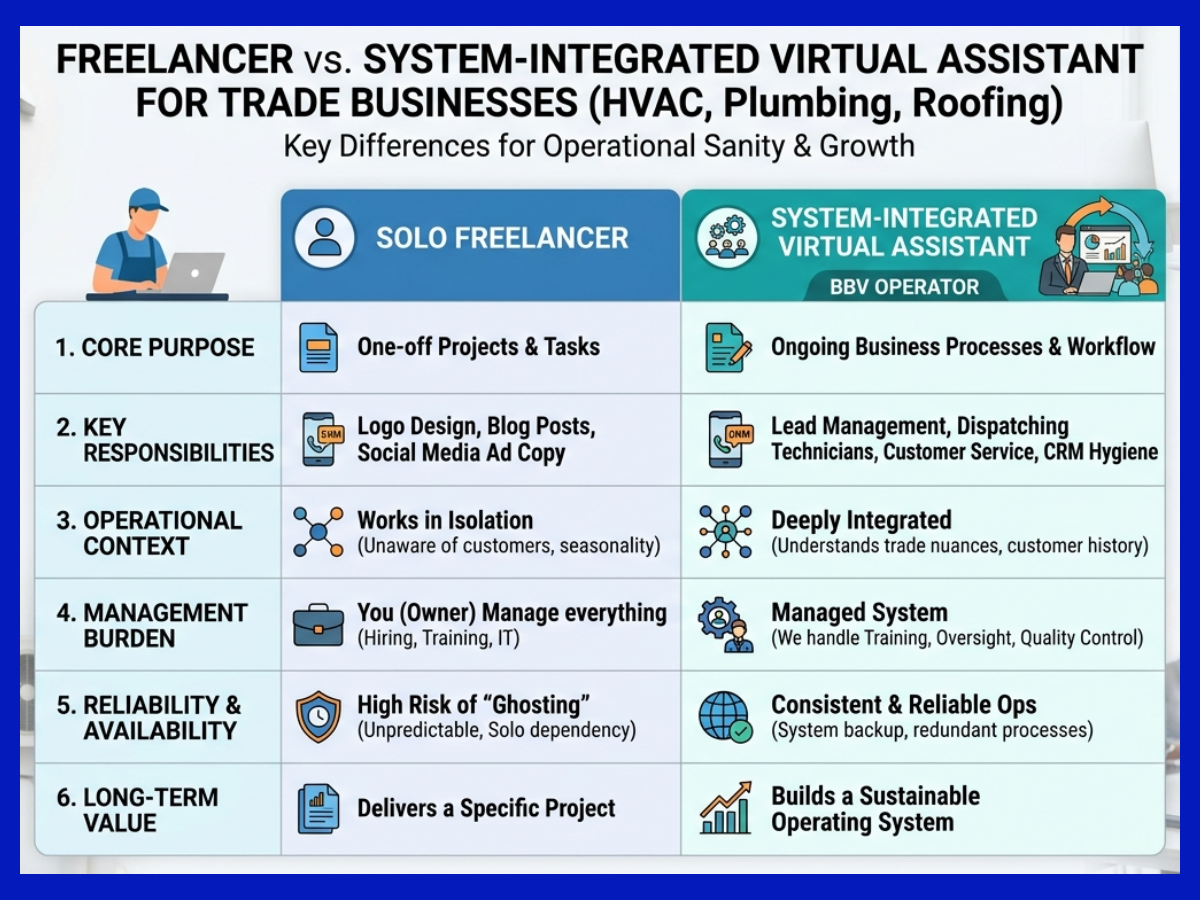
2. Context vs. Isolation
Freelancers often work in a vacuum. They don't know your customers, they don't understand your seasonal spikes, and they aren't looking at your CRM hygiene. This lack of context leads to "lost revenue" that most owners never even see.
A high-performing VA, on the other hand, becomes part of your business's DNA. They understand the nuances of the trade industry. For example, a BBV operator knows the critical difference between a routine inquiry and an emergency plumbing leak that requires an immediate technician dispatch.
They provide the Human Intelligence Layer to make judgment calls based on your specific business history—something a one-off freelancer or a basic AI bot will miss every time.
3. The Hidden Management Burden
One of the biggest red flags in traditional hiring is the hidden management burden. If you hire a freelance VA from a massive job board, you instantly become their manager, their IT support, and their quality control officer. This is where most owners fail; they spend more time managing the person than they save by delegating the tasks.
The BBV philosophy removes this bottleneck entirely. Instead of "hiring a person" and hoping for the best, you are "installing a system." We handle:
Comprehensive trade-specific training
Daily management oversight
Technical workflow automation
This professional oversight ensures that your system stays reliable, even if an individual operator has a personal emergency. You stop being a manager of labor and start being a leader of infrastructure.
4. Integration and Remote Company Culture
There is a persistent myth that remote help cannot be a true part of your company culture. In reality, a well-integrated VA often becomes more essential to the operational flow than local staff.
We have seen our BBV operators become so vital that they are included in team gatherings, celebrated in Slack channels, and treated as the "heart" of the office—despite being miles away. This level of loyalty and integration only happens when you move away from the "freelance" mindset of temporary help and invest in a permanent, system-backed solution.
5. Reliability and the "Ghosting" Reality
In the trade industry, reliability is everything. If your dispatch system goes down or your inbound leads aren't answered for four hours, you have lost thousands of dollars.
The most common "war story" we hear from new clients is about the solo freelancer who seemed great for two weeks, only to vanish right when the busy summer AC season or winter heating rush hit.
By choosing a managed hybrid system over a solo freelancer, you are building redundancy and professional oversight directly into your business. You aren't relying on one person's internet connection or personal schedule; you are relying on a professionally managed operating system designed specifically to handle the chaos of service-based businesses.
